
People often tell me apologetically that they are not very good at describing wine. In such instances, I share with them my belief that it is not their duty to excel in this activity; that's my job (and my hobby--we wine people are nerds). You'll certainly never find me apologizing to a surgeon for not being able to perform a heart transplant, or to an accountant for not being able to fill out complicated tax forms. I do believe, however, that there is one important exception to this rule. I think that anyone who enjoys drinking wine and does so on at least a semi-regular basis should know a few basic terms to describe what they like to drink. That way, the person whose job it actually is to understand the terminology and apply it to the wine list in question can be of optimal assistance in finding a glass or bottle of wine that the customer will enjoy.

Unfortunately, there is a big problem with one of the most important of these terms: 'dry.' It seems so straightforward, doesn't it? If you take it literally (and without proper instruction, why wouldn't you?), it seems to imply that drying feeling you get in your mouth after taking a sip of an intense red wine, like a Nebbiolo from Piedmont or a young Bordeaux. But no--that feeling has its own, far less obvious term: 'tannic.' Tannin, existing in the skins of red wine grapes, is what gives you the sensation that you just licked a flannel shirt. In more extreme cases, it may temporarily deprive you of the ability to separate your gums from the inside of your lip. Many people understandably mistake tannin for dryness when describing wine.
Unless you're a wine geek like me, you very well may now be wondering, "well then what is a dry wine?" The answer is definitely not intuitive, but it is simple. In the world of wine, dry is merely the opposite of sweet. Of course, we could get complicated and talk about wines that are 'off-dry' or 'semi-dry,' but that just means that they are a little bit sweet. The problem lies in the divide in understanding between the experienced winos of the world and the casual wine drinker who has never taken a formal course in wine tasting. This breakdown in communication can lead to disastrous wine selection results!
I once served a woman who was unfamiliar with many of the selections available on the wine list asked for guidance in choosing a glass. I asked her what she liked to drink and she confidently answered that she enjoyed red wines that were both dry and earthy. "Easy enough," I thought. Most earthy wines are quite dry (as in, little or no residual sugar is left after fermentation) so I assumed it would not be difficult to help her pick out her ideal beverage. I poured her a few tastes, waiting expectantly as she sipped. I was surprised when she asked if I had anything drier--it doesn't get any drier than this!

A lightbulb went off over my head and I asked her, cautiously, "what is it exactly that you mean when you say the word 'dry'?" Quickly, she answered, "you know, that feeling you get in your mouth after you take a sip when it feels really dry!" I instantly realized she was referring to tannin, and explained the confusion of the two terms. She then wrote down in her notebook for future reference that she likes "earthy, tannic wines." She ended up being quite happy with a 2004 Nebbiolo that scored high marks for her in both categories.
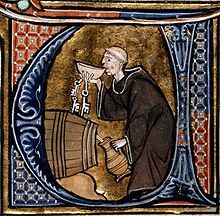
So why would such a simple and important word have such a counterintuitive definition? The answer is not quite clear. A search for the term's etymology leads simply to speculation and dead ends. Charles Hodgson's book History of Wine Words skips the subject altogether, leaving a gaping, confusing hole between 'drink' and 'Dry Creek Valley.' A prevailing theory is that the idea that sugar was once thought to 'evaporate' like water during fermentation, until it could be presumed 'dry;' another one relates to wine storage technology (or lack thereof) during medieval times, which led to a tradeoff between sweetness and astringency, so that non-sweet wines would have been more astringent (as in 'tannic' or 'dry') on the palate, and sweet wines less so.
Unfortunately, it's difficult to imagine a solution to this semantic mix-up. We can only continue the crusade to educate wine drinkers on this peculiarity for which we can probably blame the French, who first used the term vin sec (dry wine) in print around the year 1200 (although it's hard to stay mad at them when they make such delicious wine!) On the other side of the coin, I believe it is very important for bartenders, sommeliers, and restaurant servers to be cognizant and understanding of this issue. When you deal with wine day in and day out and are constantly surrounded by people who do the same, it is easy to forget that not everyone has the same knowledge of the subject. We can do our part by always remembering to ask, "what exactly is it that you mean when you say the word 'dry'?"


